Vela X-1 Wind Accretion Project
An overview of the work I have done the Blondin Research Group
Vela X-1
A high-mass X-ray binary (HMXB) is a close binary system that consists of two stars that are gravitationally bound, one of which is a white dwarf or neutron star (or more rarely a black hole) and is accreting matter from what is usually a main-sequence star that has a mass greater than ten solar masses. The companion is generally an O or B type star, emitting a stellar wind driven by radiation pressure. In the case of Vela X-1 the companion star is a blue supergiant and the primary star is a neutron star. Mass transfer to the neutron star or black hole does not proceed via Roche-lobe overflow into an accretion disk, as is the case for a low-mass X-ray binary, but rather through the capture of this stellar wind directly onto the compact object. Roche-lobe overflow occurs when the teardrop-shaped space that defines the region where the material is bound to the star by gravity becomes too full. Depending on its initial location, energy, and momentum, the material pushed outside the Roche-lobe of a star may either escape the system completely, orbit both stars or fall onto the binary companion. However, in our case, we investigate wind accretion, which happens by the gravitational capture of stellar wind coming off the main-sequence star by the compact object, rather than mass from Roche-lobe overflow. The wind speed of Vela X-1 has been debated in the literature and the effect of Roche lobe geometries on the accretion dynamics has not been investigated, so we choose to run 3D simulations of Vela X-1 with differing wind speeds and Roche lobe geometries.
3D Results - Wind Structure
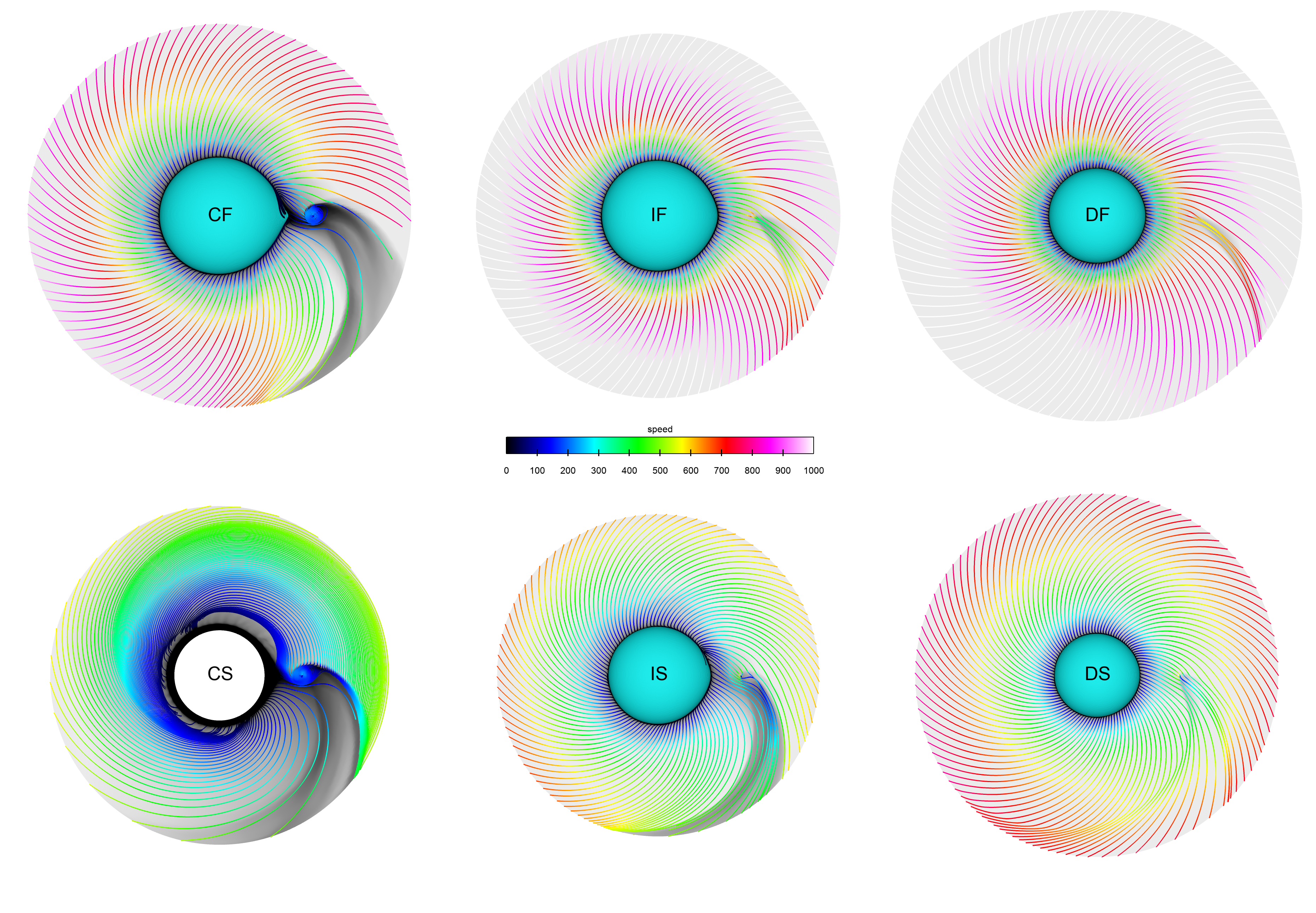
Here are some images of the results of the 3D Vela X-1 Simulations. Shown is the results of the wind flow onto the accretor. Each simulation is labeled by two letters. The first letter represents the level the Roche lobe is filled C = close (very close to filling Roche lobe), I = intermediate (between not filling and full), D = deep (a nearly spherical primary star geometry). The second letter represents the wind speed where S = slow (700 km/s) and F = fast (1200 km/s). Streamlines in the equatorial plane showing the global wind dynamics of each simulation. The effects of orbital motion are more pronounced in the slow wind models, and in the extreme case of the Slow Close model much of the wind in the equatorial plane does not escape the system. Each model is shown at the same physical scale, with the differences in radial extent of the computational grids arising from slight variations in the radial gridding tailored for each model.
3D Results - Accretion Dynamics
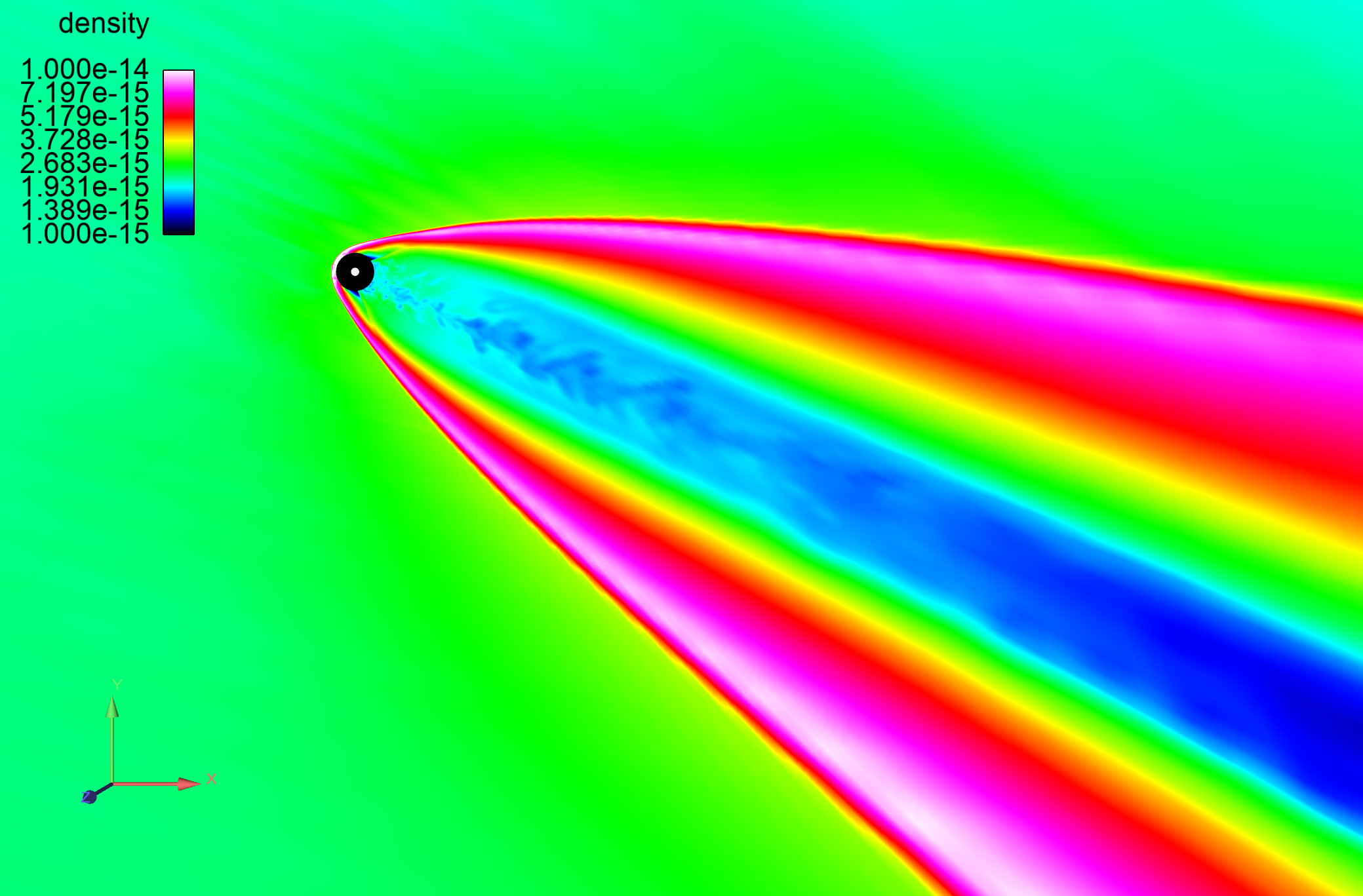
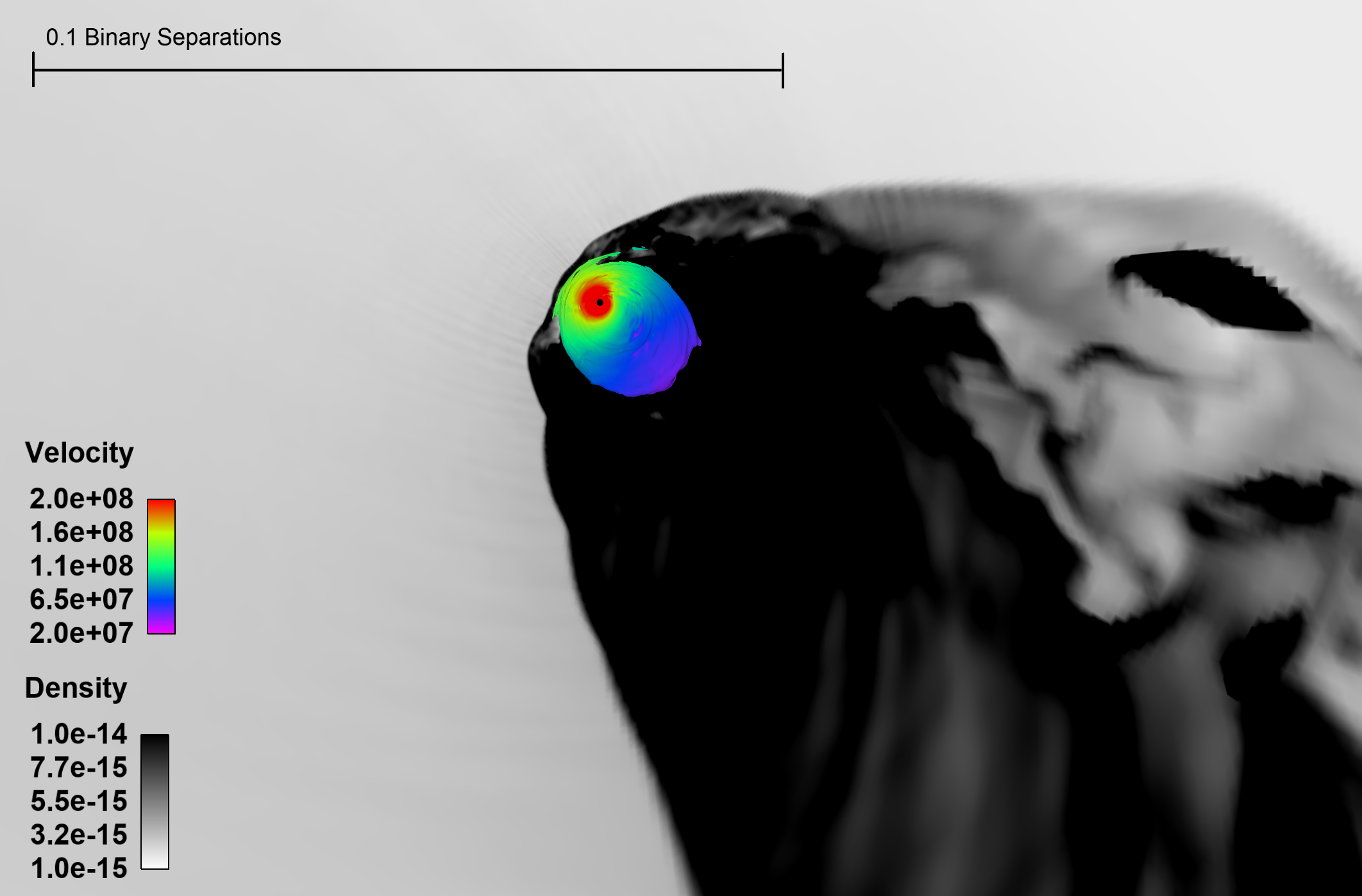
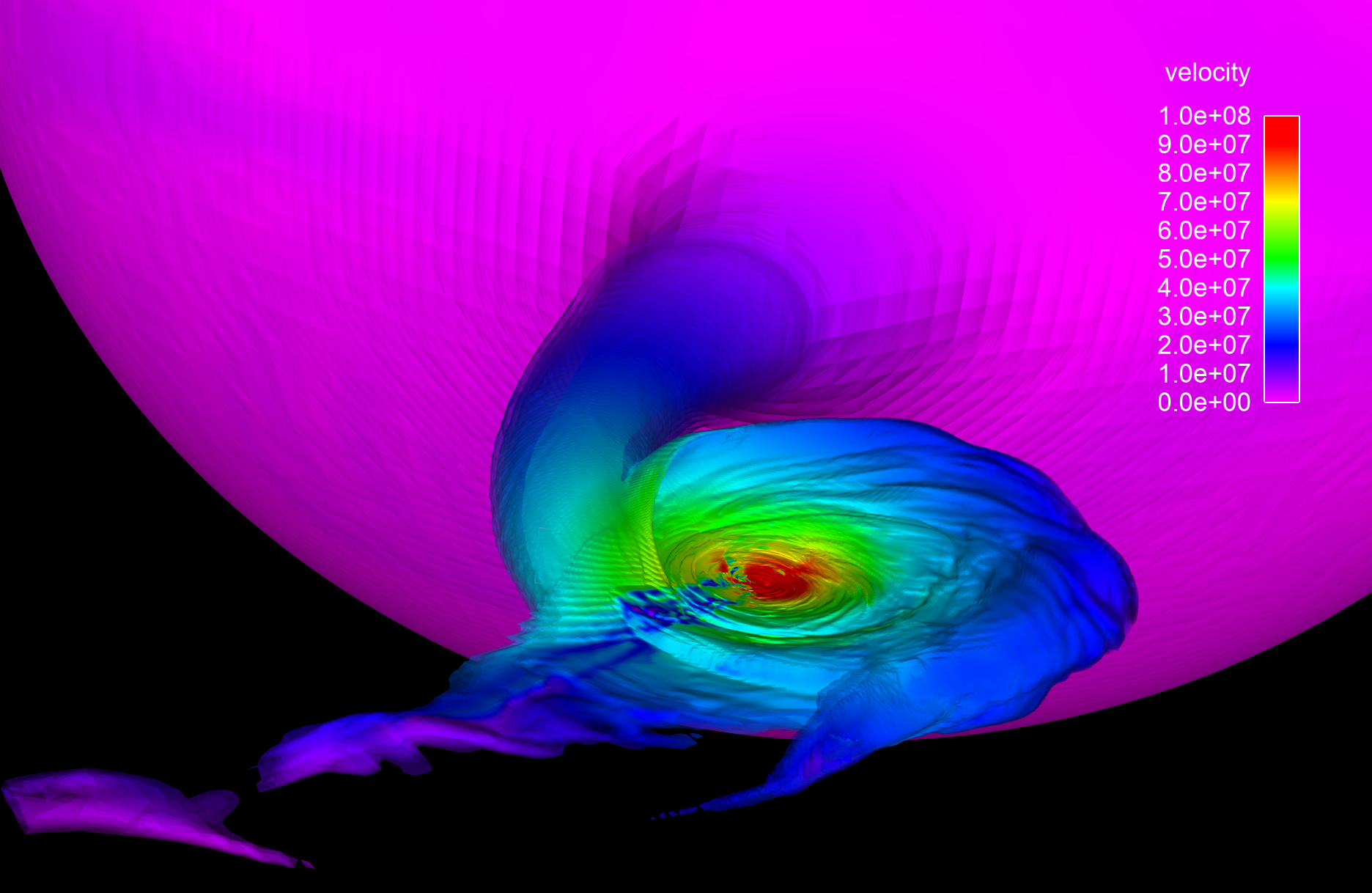
The dynamics of the accretion flow onto the neutron star companion fell into three different categories. The DF and IF simulations, due to their fast wind and correspondingly small accretion radius, possess the most uniform upstream flow and accrete via a quasi-steady bowshock as in idealized Hoyle-Lyttleton accretion models. The DS and IS simulations have larger upstream gradients due to their slower wind speeds, and while they do form an accretion bowshock, the postshock flow forms a thin accretion disk. We refer to this accretion mode as wind disk accretion. Finally, both simulations with a primary star close to the critical potential (CF and CS simulations) are dominated by a Roche Lobe Overflow tidal stream along the line of centers that feeds directly into an accretion disk. Left: Wind accretion bow shock in the Deep Fast model in the equatorial plane. Middle: Visualization of the wind accretion disk and the bow shock formed in the IS Simulation. Right: Tidally enhanced wind feeding into a quasi-steady accretion disk in the CF model.
Previous 2D Runs
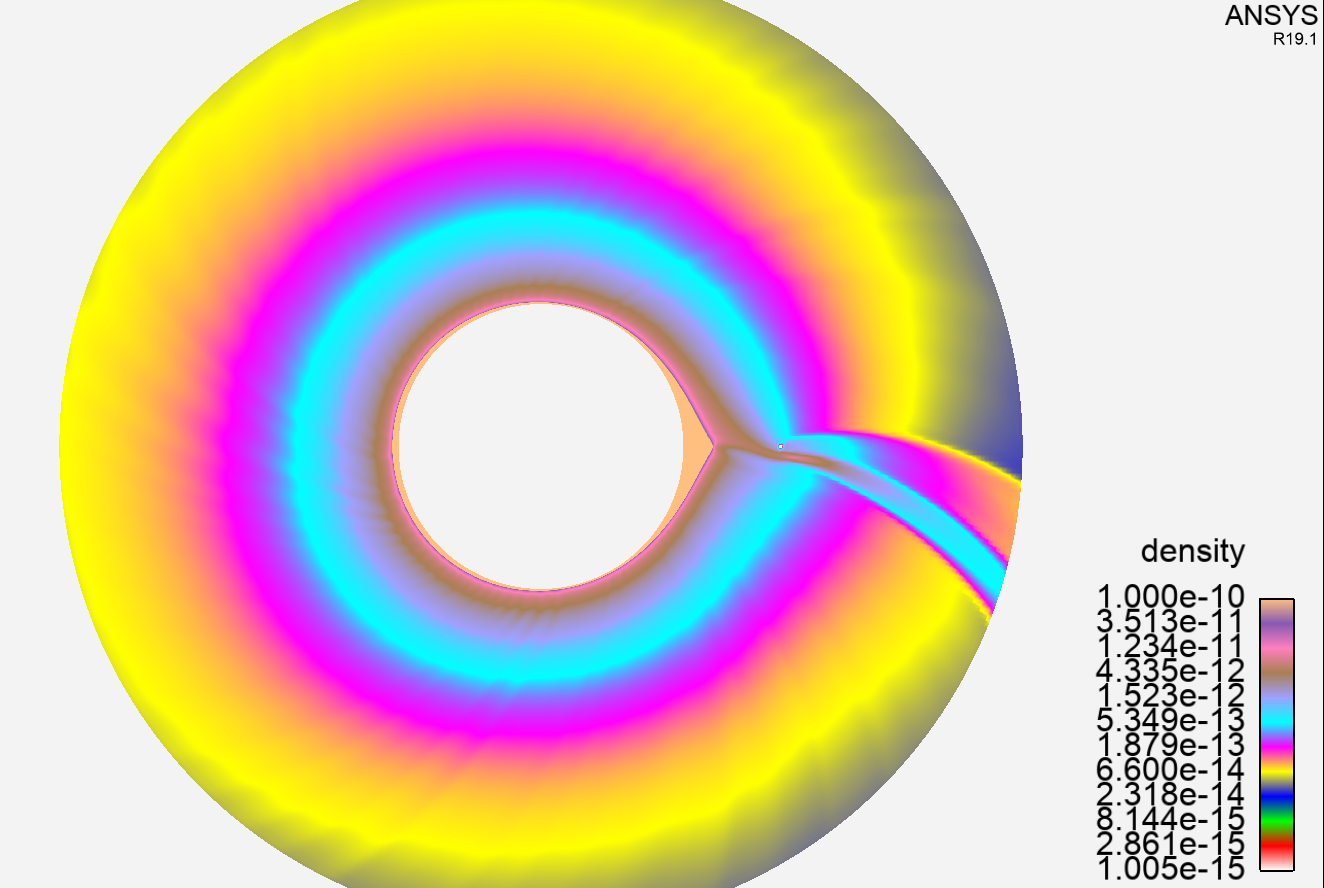
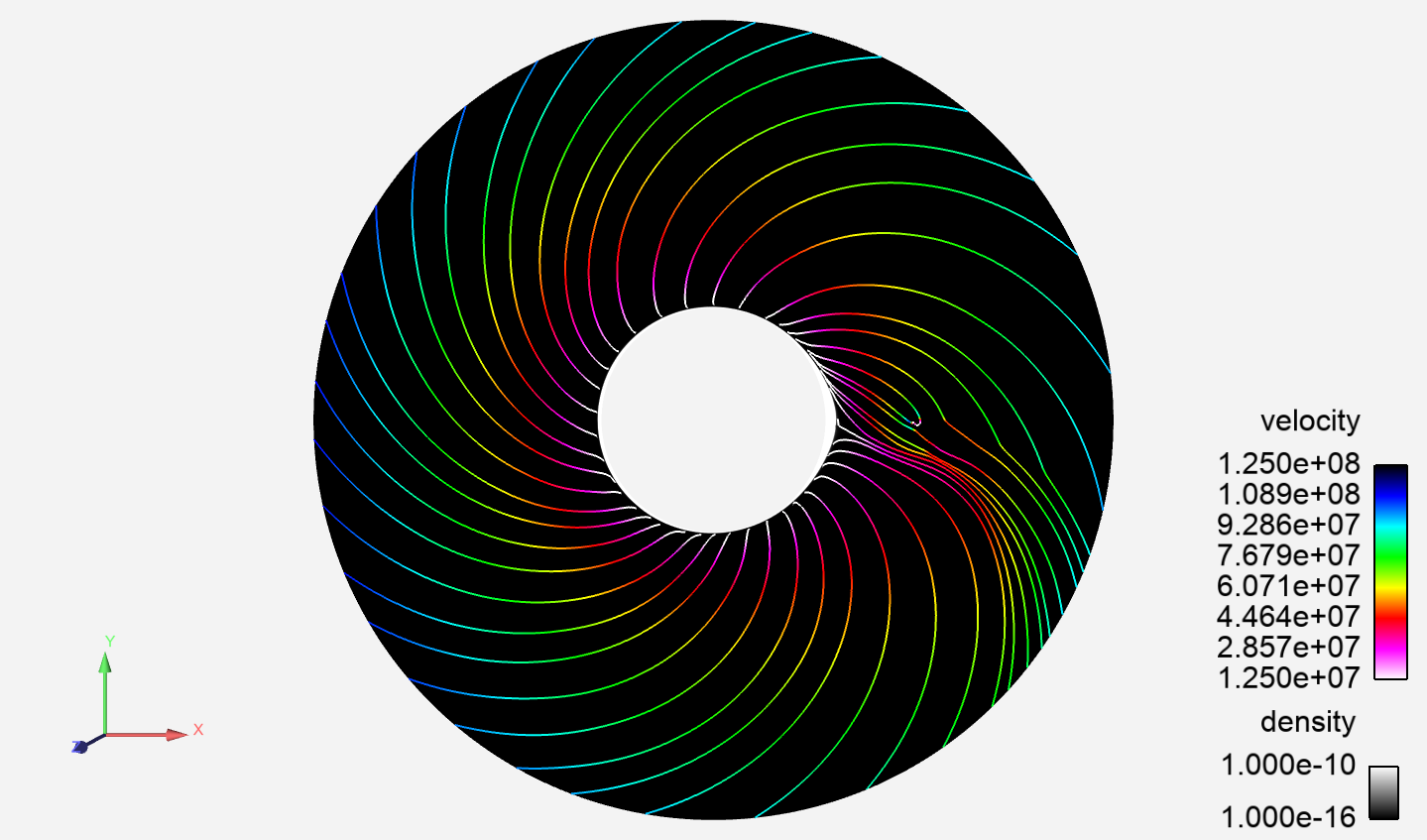
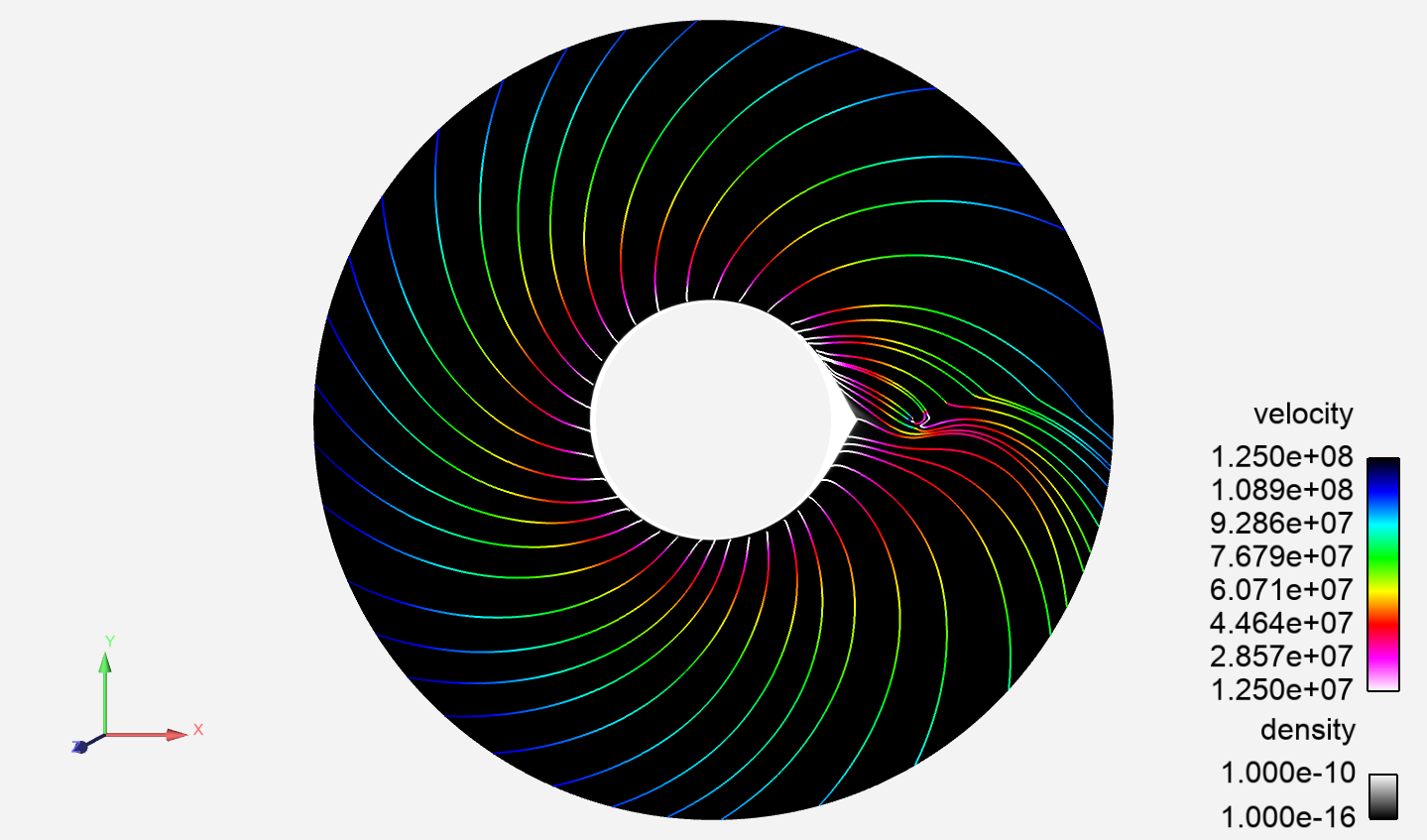
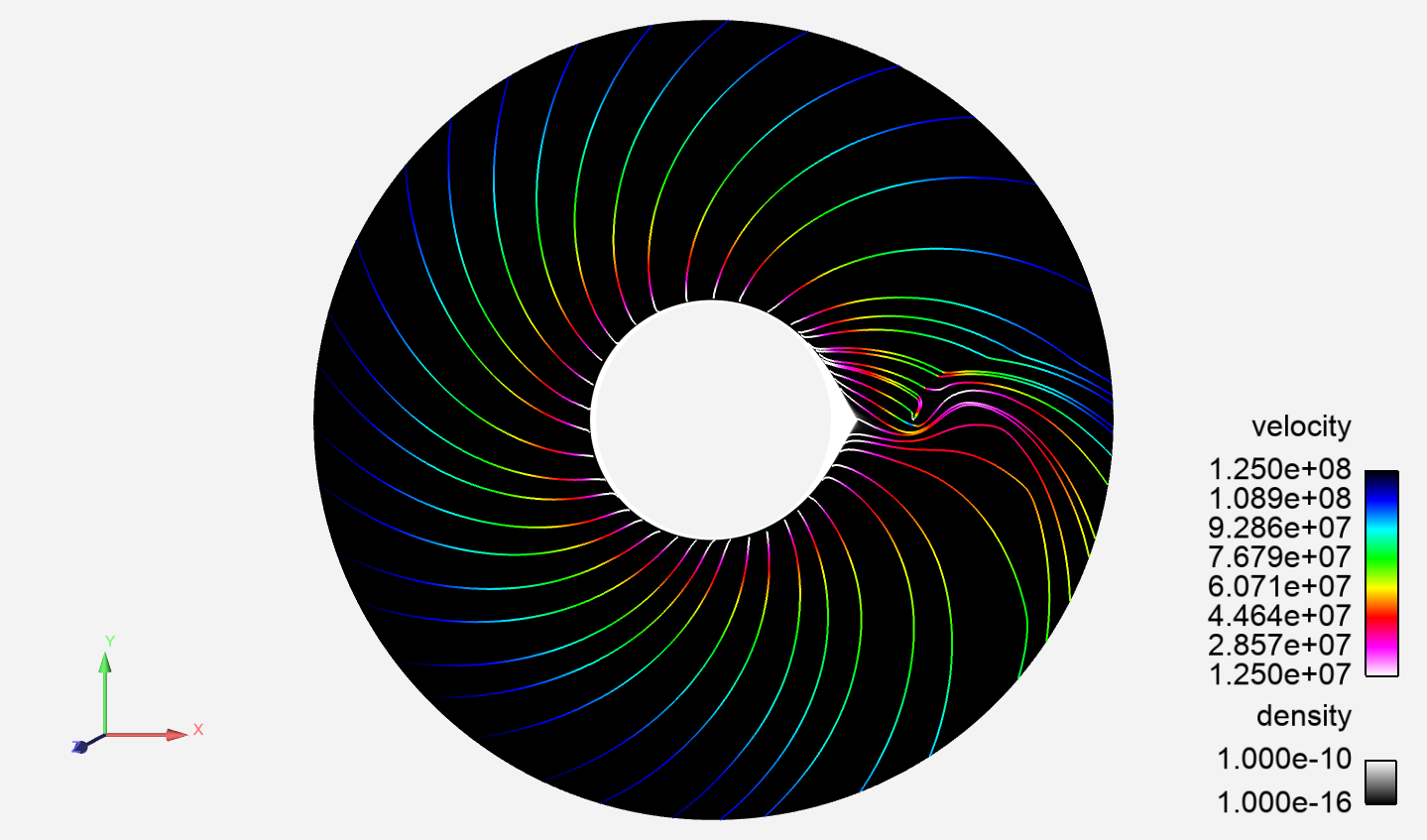
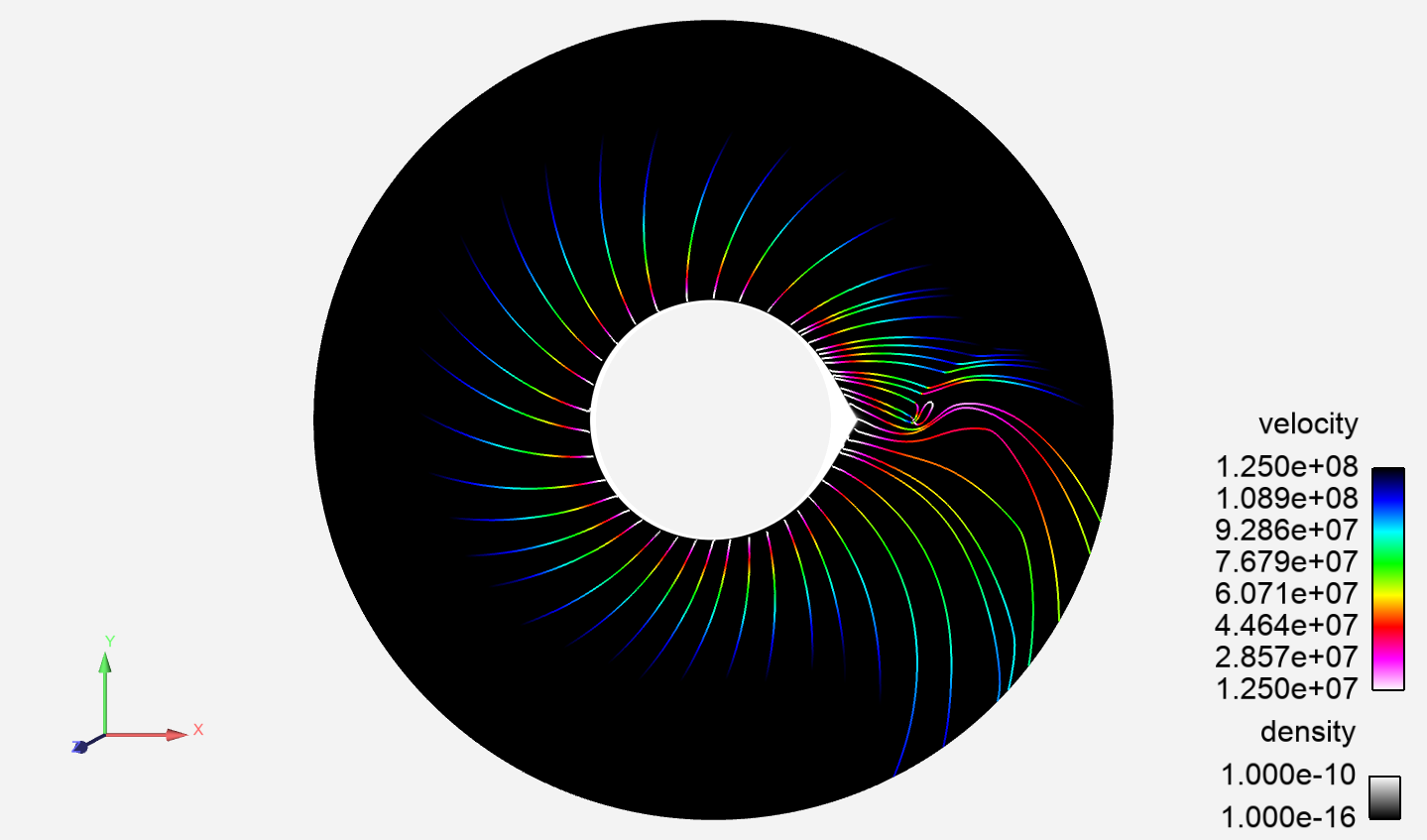
These new models below are 2D models of Vela X-1 using the Sobolev Force to alter the wind speed. While in past works Vela X-1’s windspeed was thought to be “fast” around 1200 km/s, more recent observations and theory suggests a “slow” windspeed of around 600km/s Sander et al. (2018). It was therefore decided to investigate the effects of slow, intermediate, and fast wind profiles grouped by having a filled or unfilled Roche Lobe on the wind dynamics of Vela X-1 with careful attention on the possible formation of an accretion disc around the neutron star. The small pictured models below show streamlines of the wind’s velocity vectors colored by velocity over a density colored background. The Note the high density near the L1 point and the relatively low density outside of it.
These are run with a less full Roche Lobe level and increasing speed with slowest on the left and fastest on the right.
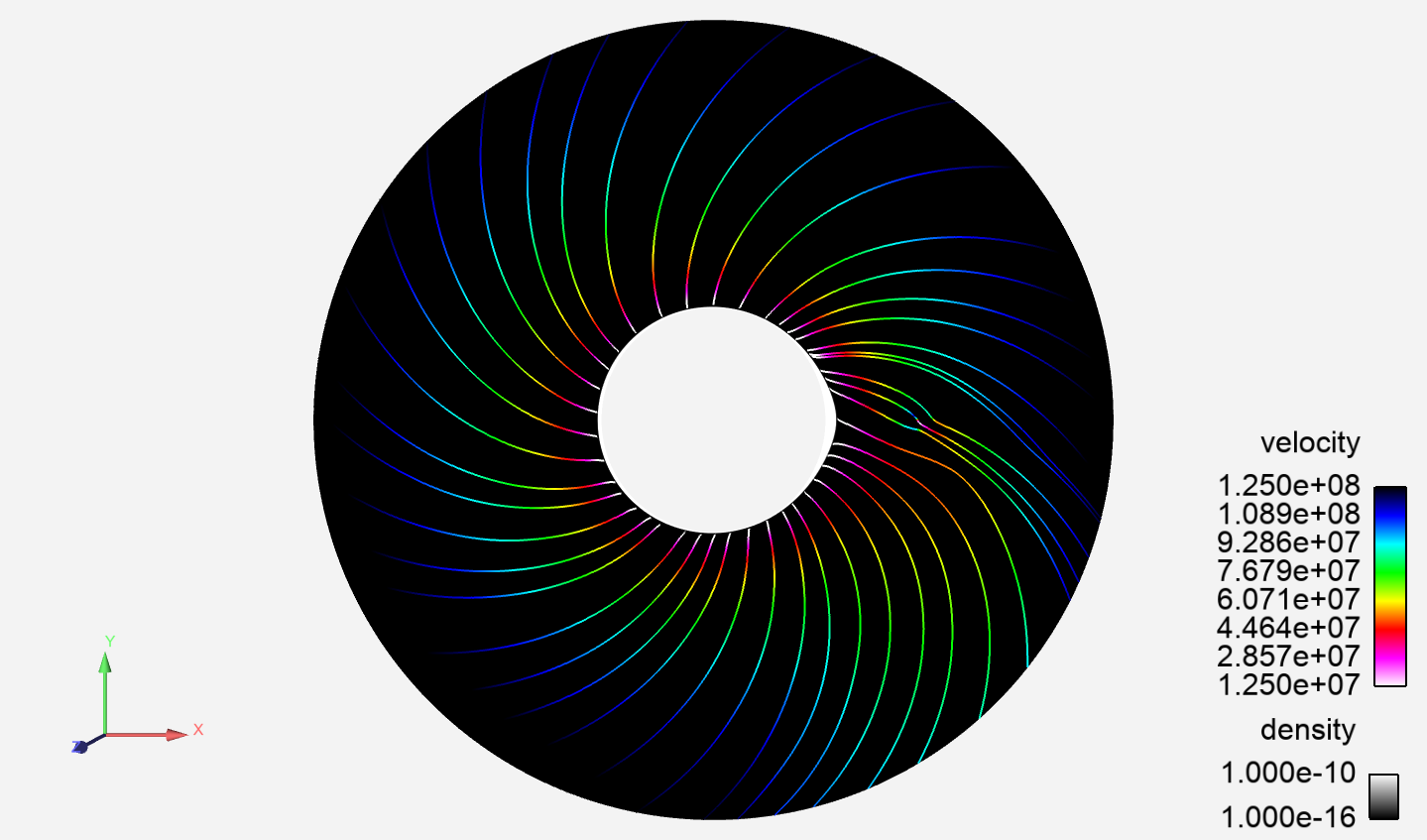
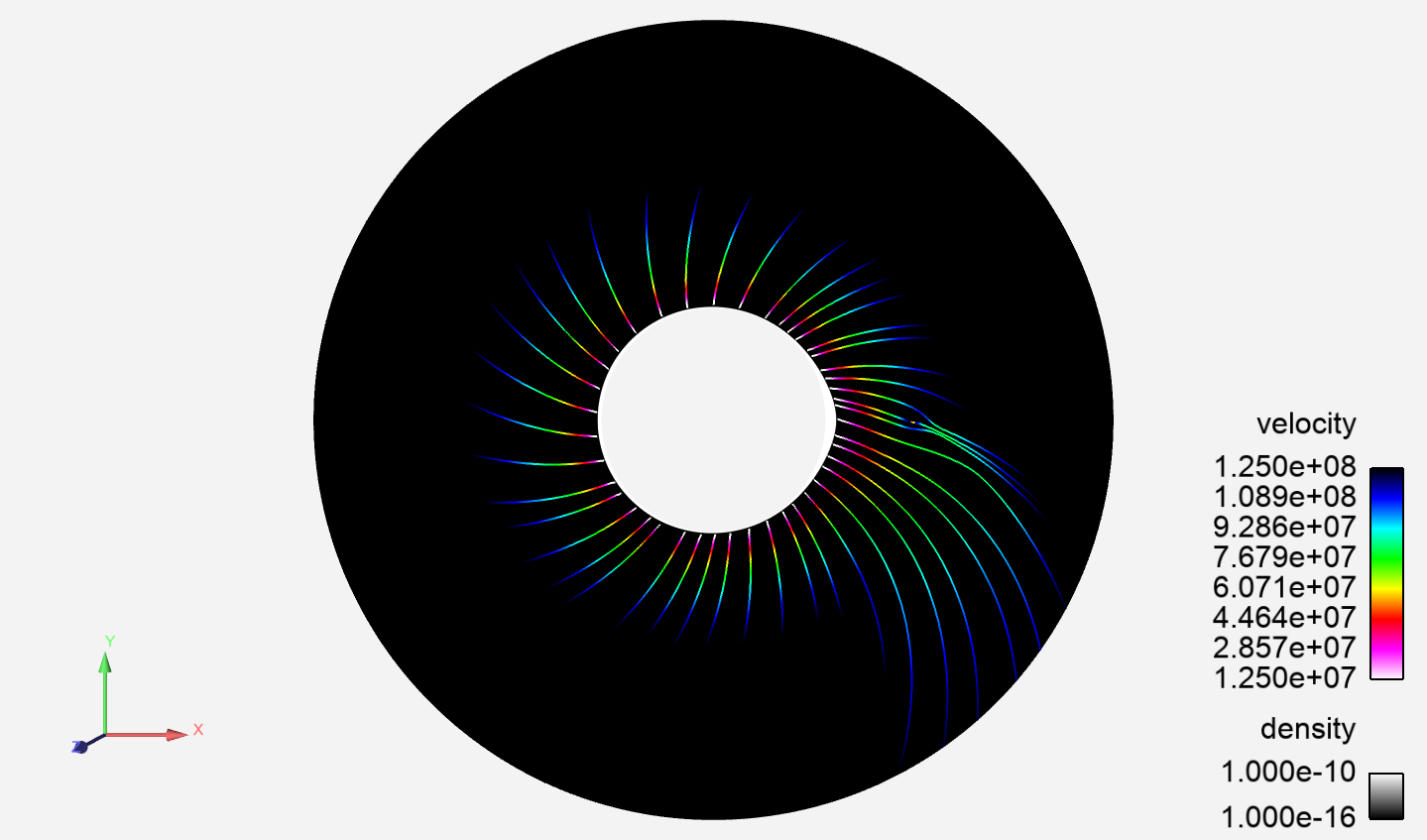
These are run with a more full Roche Lobe level and increasing speed with slowest on the left and fastest on the right.
Beginning Stages of Work
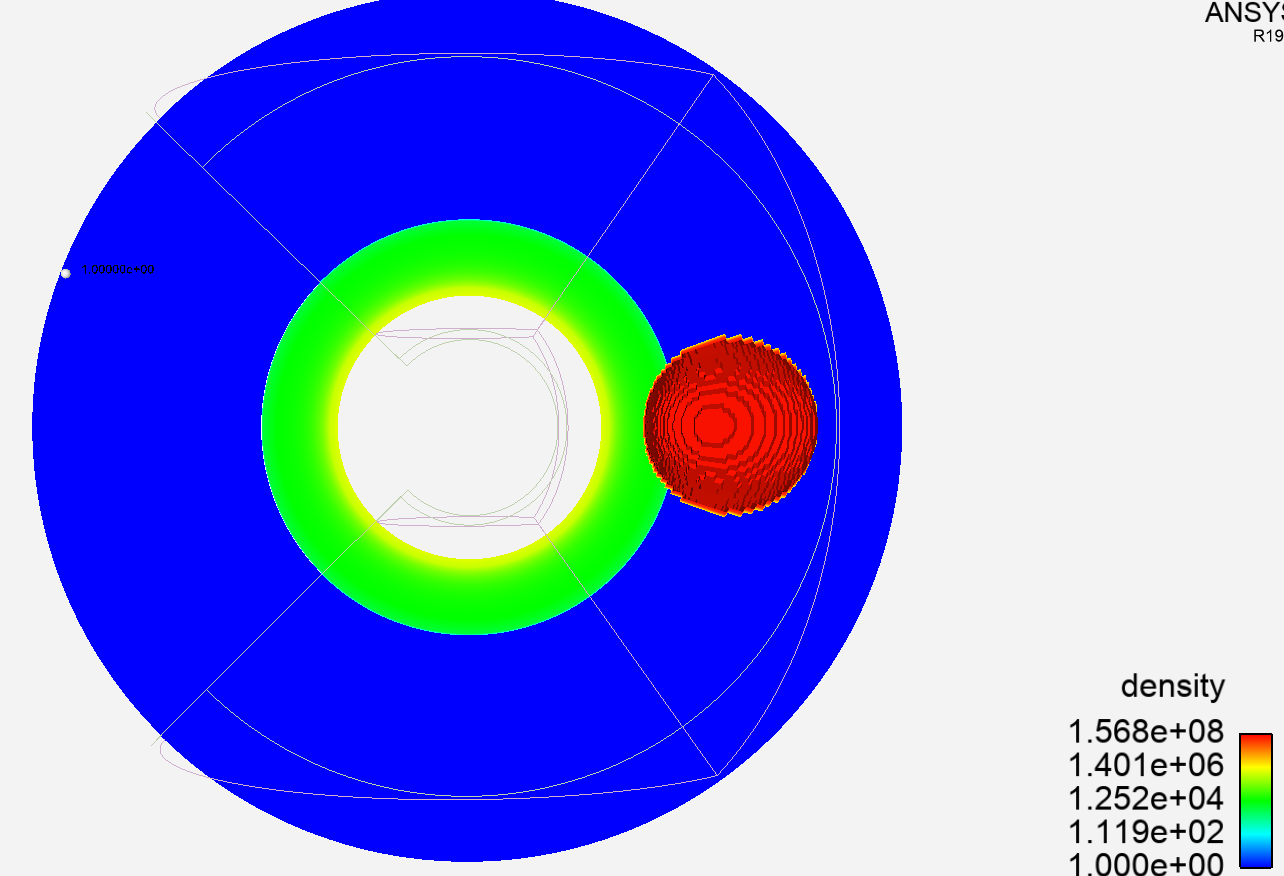
This first image is a picture of a high density cloud (in red) we put into the 3D Yin Yang code that is modeling a supernova. Learning how to do this will help us to accurately model clumpy winds if necessary in the future.
This second image is a screen shot of the phi component of velocity after, in the 3D Ying Yang code modeling an accretion, we added corotational forces into the code, to make the accretion have angular momentum, which is more like what happens in a real accretion.
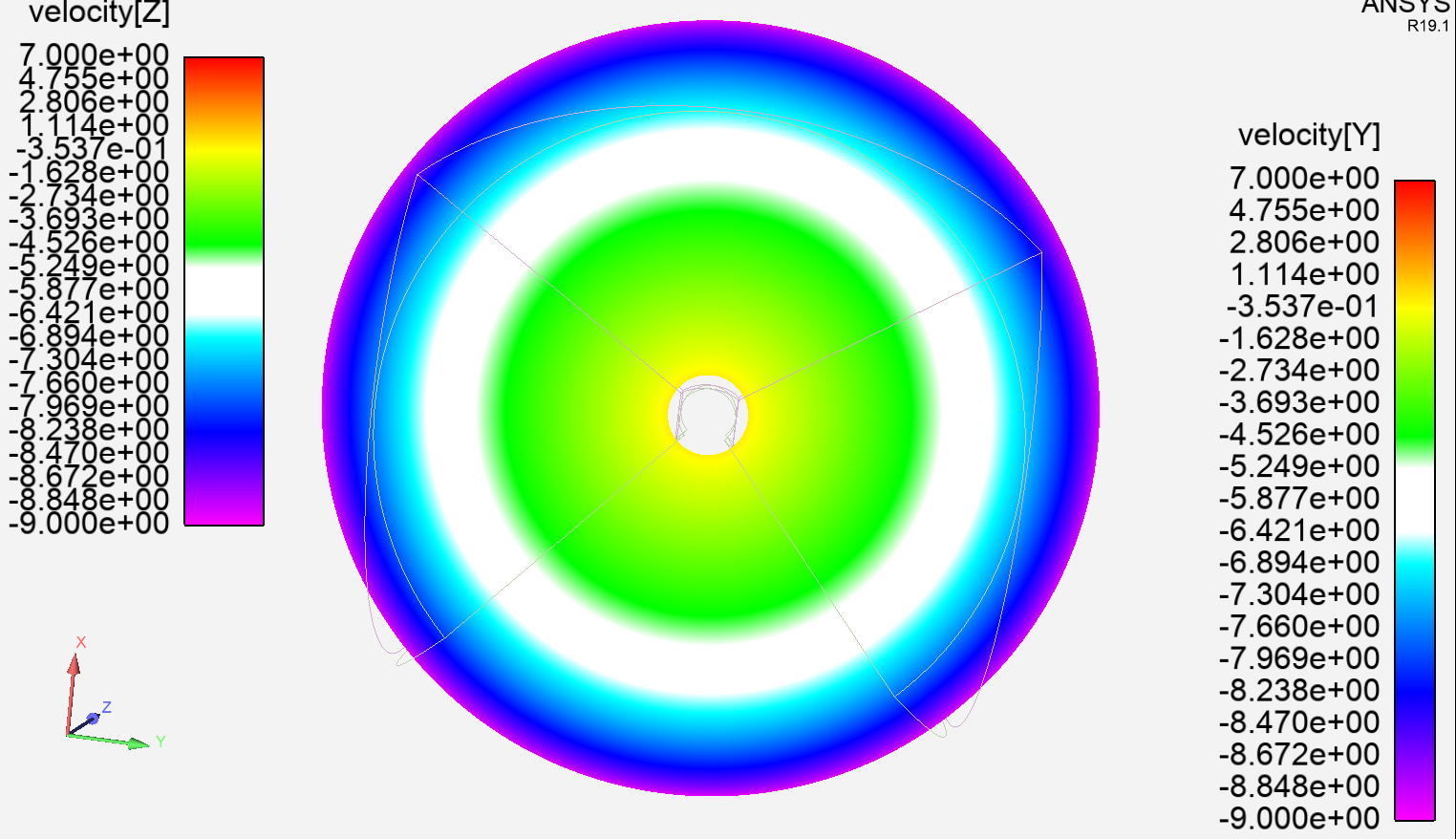
This is an image of the old Vela X-1 wind velocity model we used when first starting research. Come to find out this model was not physically correct, so now shown in the images above we use the Sobolev force model.